Apwoh Misa: A Reclamation in Sound, Memory, and Defiance, 2082
- Entertainment
-
 The Buzz Nepal
 - April 8 , 2026

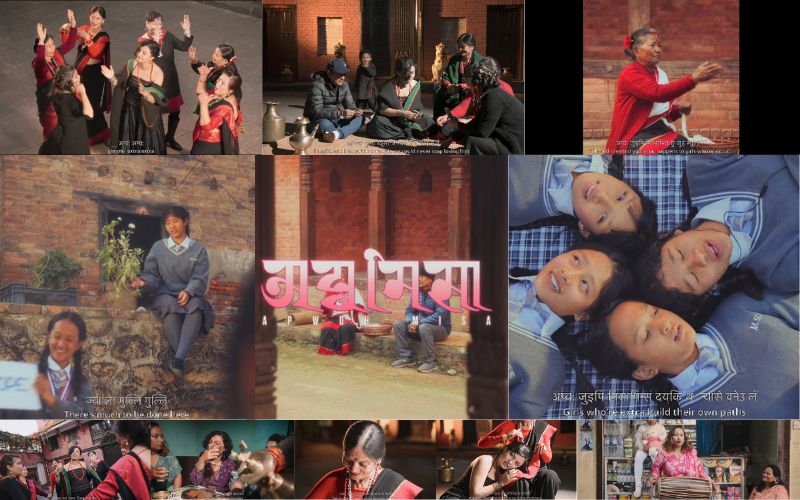
There is a particular kind of silence that is handed to girls from a young age, not given, but imposed. It arrives in small corrections, in the arching of an eyebrow, in the word “too much.” Too loud. Too opinionated. Too free. Too outgoing. Too playful. For Jyapoo Newa women and generally all women in Nepal, that silence has been centuries in the making. Apwoh Misa, the titular track of the project of the same name, refuses it.
The track is written with a kind of mischief. The artist (Ujjwala Maharjan) speaks back to the admonitions of girlhood: the rules, the reprimands, the low hum of expectation that tells a girl what she cannot do, simply because she is a girl. It is playful, but the playfulness is deliberate. It is a reminder that defiance does not always announce itself with fury. Sometimes it grins.
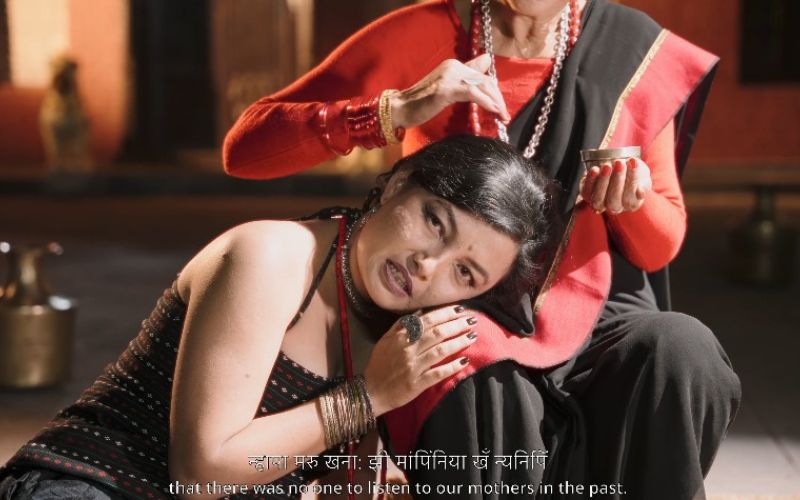
As the song progresses, the artist traces her own story as a Jyapoo Newa woman and finds it inseparable from the stories that came generations before she did. It traces back those women who were made to shrink themselves, to take up less space, to muffle whatever it was that made them “apwoh”: too much. The song becomes a thread connecting the singer’s lineage, a reckoning with inherited silence, and ultimately, a reclamation. If being whole, being visible, being loud means being “too much” ,then too much they will be.
A Sound Built from Two Worlds
The music of Apwoh Misa refuses easy categorization, which feels exactly right. The track weaves spoken word poetry and rap through a bed of rhythmic folk percussion and contemporary electronic textures, a sonic architecture that mirrors the song’s central argument: that tradition and modernity are not opposites, that identity is not a fixed point but a living, moving thing.
The production comes from Rahul Giri (_RHL), a musician whose work is defined by a thoughtful fusion of traditional and experimental sounds in the service of building entirely new sonic landscapes. His fingerprints are all over Apwoh Misa, in the way the electronic elements don’t overpower the folk but breathe alongside it, in the negative space that makes the words land.
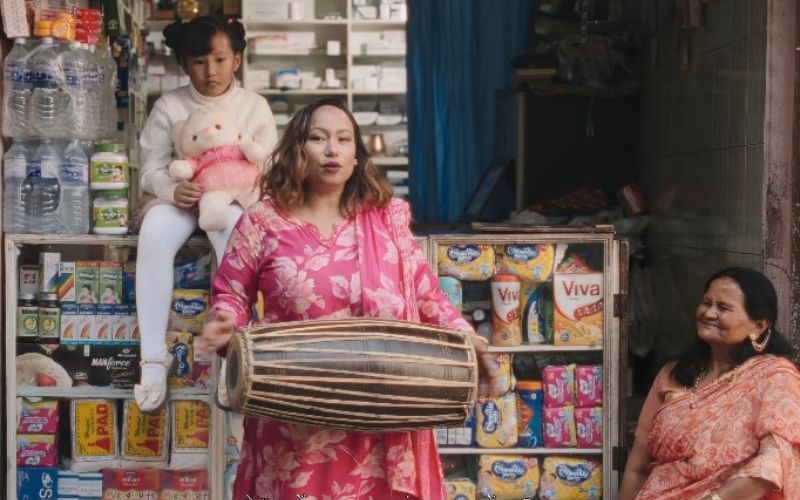
Grounding the track is the khin baja, played by Sarada Dongol, a Newari folk percussionist and one of the very few Newah women practicing traditional percussion today. That context is not incidental. In Newah cultural life, communal instruments like the khin baja were historically gatekept from women. They were discouraged from learning, sometimes outright prevented. Dongol’s presence on this track is its own act of reclamation, her rhythms carrying the weight of all the women who were told these instruments did not belong to them. She breaks the generational curse that should never have been.
A Visual Language That Expands the World
The music video for Apwoh Misa was conceptualized and directed by Suskihanna Gurung, known as BIGDIDISUSKI, an independent Nepali-Hongkong rap artist and visual storyteller whose work occupies its own fierce corner of the cultural map. Her art centers on hard-edged stories of growing up as a minority woman in the city, rendered in a style of multilingual lyricism that is at once aggressive and deeply funny, never choosing between the two.
For Apwoh Misa, Gurung brings a distinct visual language that doesn’t merely illustrate the song, it expands it. Her vision extends the world the music creates, giving the reclamation a face, a body, a place to stand.
The Buzz Take
Apwoh Misa is not a solo act of self-expression. It is, at every level, a collective gesture. It speaks of the universal experiences of women who have historically been muffled through the hands of others. It demands, and reclaims a space, for the generations of “Apwoh Misa” who have been crucial in building the current definitions of feminism and modernity in society. As the people of today, we must expand on such dialogues, and rethink critically, of all the shackles of this institution that governs us.
Also Read
Ri Mo Kathmandu Officially Debuts a Vibrant Art Kathmandu 2026 at Kathmandu Marriott Hotel
The Truth About Teeth Whitening: Why Expert Care Matters More Than Social Media Trends in 2026
Sindhur Jatra Fest II 2082 to Paint Bhaktapur Beautifully in Its Vermillion Shade.
The Science Behind Yoga: What Actually Happens to Your Body
Lactose-Free and Dairy-Free Foods for a Healthy Lifestyle in 2026
Easter 2026: The Fascinating Story, Egg Hunts & Nepal’s Celebration You Didn’t Expect
Similar News